FREE delivery & 40% Discount for next 3 orders! Place your 1st order in.
Shop Now


Mid-Year 2026: When to Upgrade Your Phone in Nigeria (And When Not To)
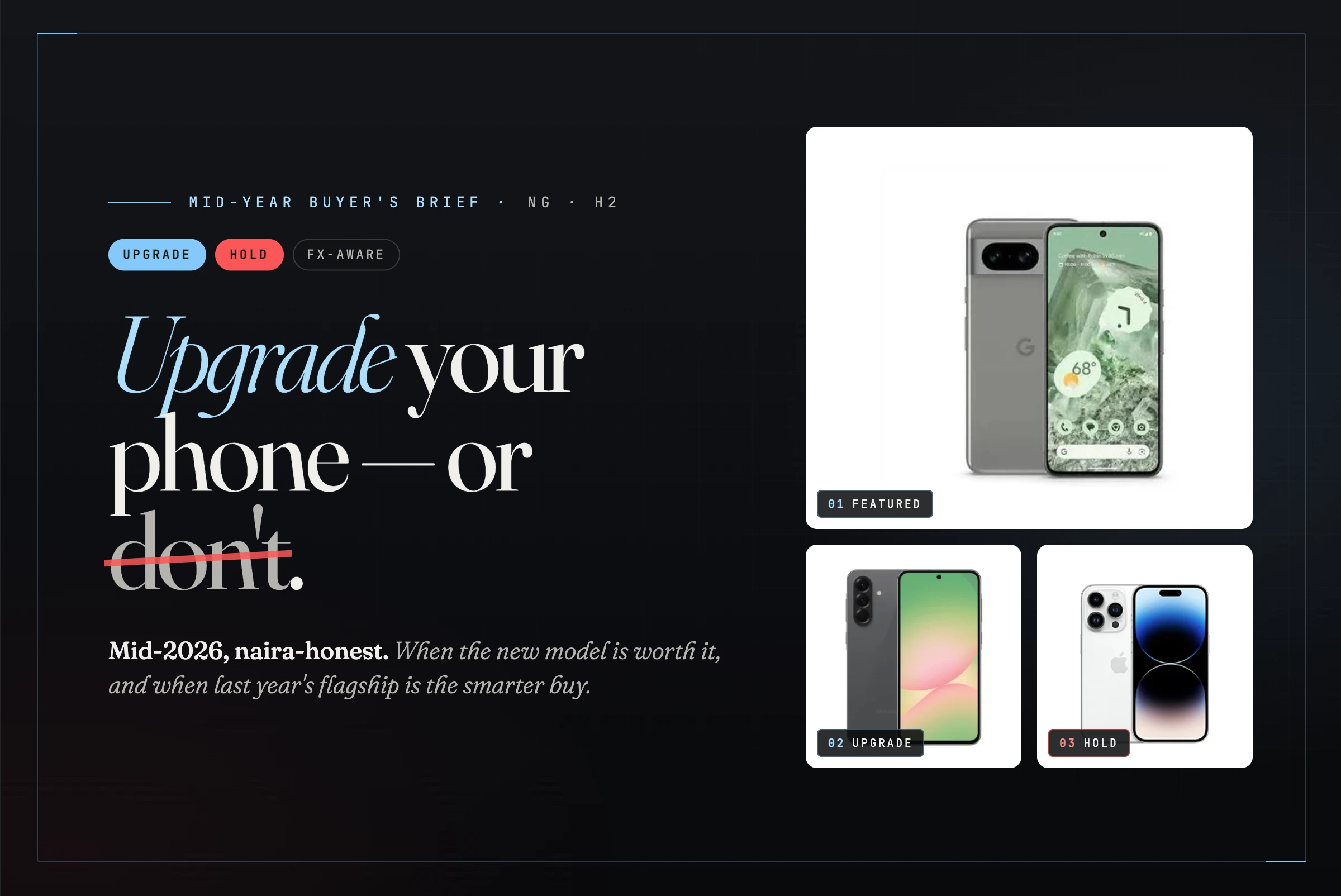
May and June are weird months in Nigeria’s phone market. The new flagships from January-February have settled into stable pricing. Mid-range models from late 2025 have dropped 15-25%. Sallah and end-of-school-term spending picks up at the same time the naira moves and import duties shift. Some of the best phone deals of the year happen between now and July.
But not every “deal” is actually a deal. And not everyone should upgrade.
Here’s how to think about it before you spend ₦300,000 to ₦2 million on a phone you’ll still be using in 2028.
When upgrading actually makes sense
Most people upgrade for the wrong reasons. They see an ad, they see a colleague’s new phone, they get bored. None of those justify ₦400,000.
Upgrading makes sense if:
Your battery dies before 4pm. This is the most common honest reason to upgrade. Phone batteries degrade in 18-30 months under Nigerian heat and charging patterns. If yours used to last all day and now needs a midday charge, the battery is shot. You can replace the battery on most phones for ₦15,000 to ₦45,000 — that’s almost always cheaper than buying new.
Storage is permanently full. If you spend more time deleting things than using the phone, and your current device is 64GB or 128GB, you’re a candidate for upgrade. Photos and videos from modern cameras have ballooned. 256GB has become the practical minimum for most people who actually take photos.
The phone is too slow to use. Slow keyboard, lag when switching apps, camera takes 3 seconds to open. This usually means the phone is 3+ years old and the chip can’t keep up with current app demands. WhatsApp alone is now significantly heavier than it was in 2022.
You need a feature your phone can’t do. 5G in areas that now have it. Better camera for content creation. Larger screen if your eyes are straining. NFC for payments. These are legitimate upgrade reasons. “It has a new colour” is not.
It can’t run your banking apps. This is the new one. Several Nigerian banking apps now refuse to run on Android versions older than 9 or 10. If your phone is stuck on an older OS and can’t update, you have a real problem.
When you should NOT upgrade
Your phone “feels old” but works fine. Boredom is not a reason to spend ₦500,000. Buy a new case, clean up your home screen, learn one new feature your phone has — see if that fixes it before you fix it with money.
The screen has one small crack. A screen replacement is ₦25,000 to ₦150,000 depending on phone. Almost always cheaper than a new phone.
Battery is weak. As above — replace the battery first.
You bought it less than 18 months ago. The performance and feature improvements between a 2024 mid-range and a 2026 mid-range are smaller than the marketing makes them sound. Wait another year.
You can’t actually afford it. A phone bought on a “small monthly payment” that stretches your budget is not a deal. It’s a loan with a phone attached.
The four price tiers in 2026
Phone pricing in Nigeria has stratified clearly. Knowing which tier you’re shopping in saves time.
Entry (₦80,000 to ₦180,000). Tecno Spark, Infinix Hot, Itel basic Android. These are honest phones for honest money. They work, they make calls, they run WhatsApp, they take acceptable photos in daylight. They struggle in low light, the screens are not premium, and they slow down within 2 years. If your budget is here, this is fine — don’t stretch to ₦300,000 to “future-proof,” because the ₦300,000 phone won’t last meaningfully longer.
Mid-range (₦200,000 to ₦450,000). Tecno Camon, Infinix Note, Redmi Note, Samsung Galaxy A series, older iPhone SE. This is where most Nigerian buyers should shop. The cameras are genuinely good, the screens are bright enough for direct sunlight, the batteries last all day, and the phones stay fast for 3+ years. The improvement from entry to mid-range is dramatic. The improvement from mid-range to premium is small.
Premium mid-range (₦500,000 to ₦900,000). Samsung Galaxy A series higher trims, Tecno Phantom, Infinix Zero, refurbished iPhone 13/14, Pixel 7a. You’re paying for better cameras, better build, and faster processors. Worth it if you actually use the camera seriously or you’re hard on phones.
Flagship (₦1 million and above). iPhone 15/16, Samsung Galaxy S24/S25, Pixel 9. Excellent phones, but you’re paying ₦600,000+ more than the premium mid-range for incremental improvements. If you’re a heavy content creator, mobile gamer, or you genuinely use the better camera daily, justify it. If you mostly use WhatsApp, Instagram, and a few banking apps, you’re spending money to feel a certain way.
New, UK-used, or refurbished?
Three honest options in Nigeria’s market:
Brand new from an authorised dealer. Highest price, full warranty, no surprises. The right choice if you can afford it and you want zero risk.
UK-used / foreign-used. These are second-hand phones imported from abroad, usually 12-24 months old, often in good condition. Prices are 30-50% lower than new. The honest risks: battery may be at 80% capacity already, no manufacturer warranty in Nigeria, occasional regional locks or eSIM issues with iPhones. For Android phones, UK-used can be excellent value. For iPhones, check carefully that it’s a true unlocked international model.
Nigerian-used (tokunbo). Phones already used in Nigeria, resold. Bigger price drops, but harder to verify history. Battery is almost always worn. Often missing original chargers or boxes. Suitable if you know what you’re checking and the seller is reputable.
The general rule: for a phone under ₦300,000, buy new if you can. For a phone above ₦600,000, UK-used often makes more sense — the saving is large enough to absorb the small risks, and a top-tier UK-used phone outperforms a brand-new mid-range phone.
The accessories conversation
The phone is the obvious purchase. The accessories are where most people spend badly.
Cases and screen protectors. Buy these on day one. A ₦5,000 case and a ₦3,000 screen protector save ₦80,000 in screen repairs. The fancy ₦25,000 cases look nicer but don’t protect meaningfully better than the ₦5,000 ones. Get the cheap one.
Chargers and cables. Use the charger that came with the phone, or a same-brand replacement. Cheap unbranded chargers degrade the battery measurably. This isn’t an old wives’ tale — fast-charging phones are designed for specific voltage profiles, and ₦1,500 chargers from the roadside often don’t match. Same for cables.
Power banks. A 20,000mAh power bank is the right size for a Nigerian phone. Smaller ones don’t last long enough; bigger ones are too heavy. Brands that work consistently here: Oraimo, Romoss, Anker. Avoid unbranded “30,000mAh” power banks at suspicious prices — the actual capacity is usually a third of what’s claimed.
Earphones. Wired earphones are dead. Bluetooth earphones under ₦15,000 are dramatically better than they were two years ago. Spend ₦20,000 to ₦40,000 once and you’ll have something genuinely useful for daily use.
Memory cards. Phones with expandable storage benefit from a good microSD. Buy SanDisk or Samsung. Anything else is risky. A ₦12,000 128GB card from a trusted brand is worth far more than a ₦5,000 “256GB” card that fails after three months and takes your photos with it.
Timing the purchase
Two windows are usually best for phone buying in Nigeria:
May to July. Mid-year pricing adjustments, mid-range models from the previous year are at their lowest before new models arrive. Sallah and back-to-school demand pulls in promotions.
Late November to early December. Black Friday and pre-Christmas sales are real, but you need to verify the “discount” is real. Many vendors raise prices in October to drop them in November to a level that’s actually the regular price.
The worst time to buy: January and February, when new flagships launch at peak prices and previous-year models are still being cleared at slow rates.
How to verify what you’re actually buying
Before paying for any phone:
- Power it on and check the IMEI matches the box (dial *#06#)
- Check the screen for dead pixels (look at a plain white image full-screen)
- Test the camera in low light, not just bright daylight
- Check that all buttons work, including volume rocker
- Test the speaker and the call earpiece separately
- Check that charging works with the included cable
- For UK-used: check the battery health (Settings > Battery > Battery Health on iPhone; harder on Android but apps can help)
- For iPhones: verify it isn’t iCloud locked
A reputable vendor will let you do all of this before paying. A vendor who rushes you or refuses is telling you something.
The bottom line
The right phone for most Nigerian buyers in 2026 is a mid-range Android (₦200,000 to ₦450,000) or a UK-used iPhone 13 or 14 in that same price range. These phones will serve you well for 3+ years. The flagship purchase is rarely the smart purchase unless you have a specific reason.
Spend the ₦400,000 you would have spent on a flagship on a mid-range phone plus a good power bank plus a case plus 256GB of cloud storage for three years. You’ll have a better overall setup than the person with just a flagship and a maxed-out 128GB.
The phone you use every day matters. The phone you bought to impress people you don’t actually talk to doesn’t.