FREE delivery & 40% Discount for next 3 orders! Place your 1st order in.
Shop Now


Rainy Season 2026: What to Fix on Your Car and House Before July
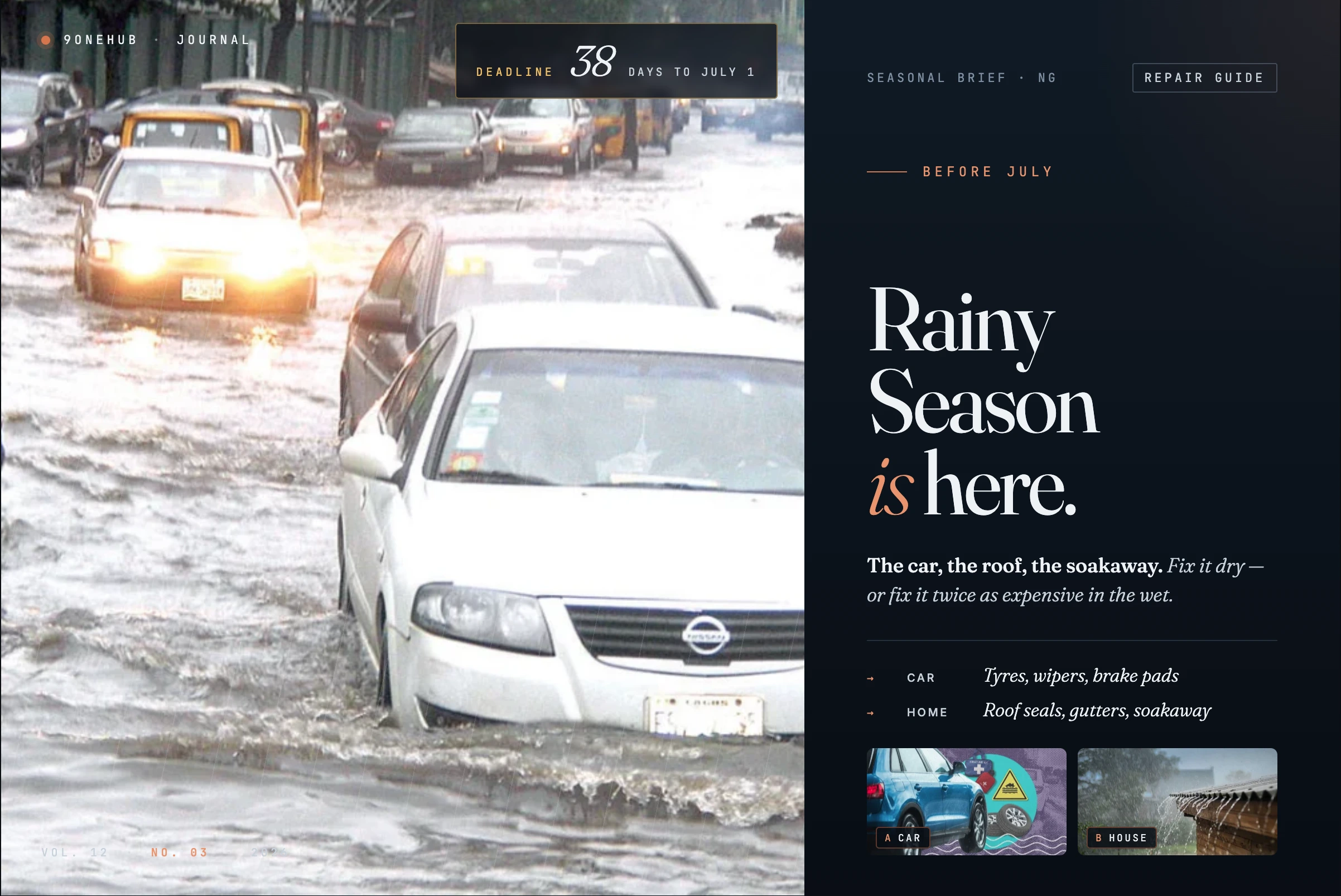
NIHSA’s 2026 flood outlook flagged over 30,000 communities at risk across 33 states. Lagos is forecast for above-normal rainfall. The peak window — when most of the damage actually happens — is July through September.
You have about six weeks.
If your car or your house has issues that get worse in the rain, this is the period to fix them. By August, every mechanic is overbooked, every roofer is on a job, and every building materials shop has price-jumped because demand is peaking. The cheapest time to do rainy-season repairs is right now, before everyone else realises they should have done them.
What goes wrong on Nigerian cars in the rain
Three categories of car problems spike between June and September: visibility, traction, and electrical.
Wipers and windscreen. The single most ignored part of a Nigerian car is the wiper blade. Most have been on the car for two or three years and have hardened in the harmattan and dried out in the sun. They smear water across the windscreen instead of clearing it. In a heavy downpour on Third Mainland Bridge, that smear is the difference between seeing the brake lights ahead and not seeing them.
Replace wiper blades now. They cost ₦4,000 to ₦12,000 depending on car. They take 5 minutes to fit. There is no reason to enter July with old wipers.
While you’re at it, top up the wiper washer fluid. The bottle under the bonnet that everyone forgets exists.
Tyres. Bald tyres on wet roads kill people in Nigeria every year. The tread depth that’s acceptable in the dry season is dangerous in the rain. If you can see the wear bars across the tread, or if the pattern is shallower than your fingernail, replace before July.
You don’t need premium tyres. You need tyres that aren’t worn to the canvas. A mid-range Chinese tyre with full tread will outperform a premium tyre worn to 80% on a flooded road.
Check tyre pressure weekly during rainy season. Under-inflated tyres hydroplane sooner. Over-inflated tyres reduce contact patch.
Brake pads and discs. Wet roads need longer braking distance. Brake pads that are 70% worn but tolerable in the dry season become a problem in the rain. If you hear any grinding, scraping, or feel the pedal going lower than usual, this is the month to fix it.
Battery and electricals. Rainy season weather kills weak batteries faster than dry season heat does. The starter motor pulls more current when the engine is cold and damp. If your battery is more than 2 years old and starts slow on harmattan mornings, replace before the rains come properly.
Check that headlights, taillights, brake lights, and indicators all work. Many Nigerian cars have one or two bulbs out at any given time. In a heavy storm at night, you want every light functional.
The boot/cabin water test. Park your car somewhere it can sit in the rain (or pour a bucket of water over the roof and around the doors). Get in. Look for any sign of water entering through door seals, the windscreen, the roof, or the boot. If you find a leak, fix it now — it’s a ₦5,000 problem in May and a ₦50,000 problem in August after the electronics under the carpet have shorted.
Suspension and ground clearance issues
Bad roads + heavy rain + potholes you can’t see under the water = bent rims, broken shocks, snapped tie rods.
If your suspension already feels rough, it’s going to get worse. The pothole that you can see and steer around in May becomes invisible in June when it’s full of muddy water. The car that’s already complaining about a worn shock will give up entirely after the third hard hit.
Get the front end checked. Ball joints, tie rod ends, control arm bushes — these are the parts that fail most often after rainy season pothole hits. Replacing them now is much cheaper than replacing them after they break and damage other components.
The house side: stop water before it enters
Most flooding damage to homes isn’t from the dramatic flash floods you see on the news. It’s from slow leaks, blocked gutters, and unsealed gaps that let water work its way into walls, ceilings, and floors over weeks of rain.
The roof check. Walk around your house and look at the roof from the ground. Any missing or cracked tiles? Any visible gaps where the roofing sheets meet the walls? Any rust on iron roofing? If you can see the problem from the ground, the water can find the way in.
For zinc/aluminium roofing, common problem areas:
- Where roofing screws have rusted out and left holes
- Where roofing sheets overlap and the seal has degraded
- Where the roof meets the parapet wall
- Around vents, chimneys, and antenna mounts
A tube of roof sealant costs ₦3,000 to ₦8,000. A bag of cement and a few roofing screws can solve most of the visible issues for under ₦15,000 of materials. The labour to do it properly is ₦20,000 to ₦60,000 depending on house size. Doing this in May is cheap. Doing it in August during an active leak is not.
Gutters and drainage. This is the single highest-ROI rainy season task: clear the gutters around your house. Leaves, sand, and rubbish accumulate in dry season and block flow. The first heavy rain backs water up onto the roof or against the walls. Two hours of work with a ladder and a bucket prevents weeks of damage.
If your compound drains poorly — water pools near the house, or the front gate area floods — get this fixed before July. A small concrete drainage channel costs ₦40,000 to ₦150,000 of materials. The cost of repainting walls damaged by standing water is much higher.
Doors and windows. Check window seals and weather strips. Check that doors close fully against their frames. Wet wind drives water through gaps that don’t bother you in the dry season. Replace cracked window glass before July.
Waterproofing critical areas. If you have a flat roof, a balcony, or a terrace, check the waterproof membrane. Cracks in flat roof concrete let water through into the rooms below. Waterproof sealants and membranes are widely available. This is one of those jobs you either do in May or regret in September.
Materials worth buying now
If you’re doing any of the work above, prices on these items climb 15-30% between June and September as demand peaks:
- Roofing sheets and roofing screws
- Cement
- Waterproofing compounds and sealants
- PVC drainage pipes and fittings
- Window glass and door frames
- Paint (especially exterior weather-resistant paint)
Buy what you need in May while supply is normal and prices haven’t moved. Even if you can’t do the work immediately, storing the materials is fine — most don’t degrade.
The flood-prone area question
If you live in one of the areas NIHSA has flagged as high-risk — Lagos low-lying areas, Niger Delta, parts of Benue, Kogi, Anambra, Bayelsa, Rivers — the calculation is different. You’re not just managing inconvenience. You’re managing potential displacement.
Things to consider:
- Raising key electrical sockets above the typical flood line
- Moving important documents and electronics to higher floors or higher shelves
- Sandbags or flood barriers at doorways
- A small pump that can clear water from low-lying parts of the compound
- Insurance — if your home or car insurance doesn’t cover flood damage, this is the time to find out
The communities that took these steps in May 2024 lost less than the ones that took them after the first heavy rain.
What this all costs vs what it saves
Doing the full rainy-season prep on a small car runs ₦80,000 to ₦200,000 depending on what needs replacing. The cost of one accident from worn tyres, or one engine failure from a damp electrical short, is many times that.
Doing the full house prep runs ₦50,000 to ₦300,000 depending on size and condition. The cost of replacing damaged ceilings, walls, furniture, and electronics after a season of leaks is many times that.
The cheapest months to do this work are May and June. The most expensive months are August and September. The reason isn’t material costs — it’s labour availability, urgency premiums, and the cost of the damage already done.
Six weeks to peak flood season. Plenty of time to get this sorted properly.